
[ad_1]
Nadine Dorries should lose party whip if she does not resign, says senior Tory
Caroline Nokes, the Conservative MP who chairs the Commons women and equalities committee, has told Times Radio that if Nadine Dorries does not resign from parliament, as she said she would, she should lose the Tory whip. Nokes said:
She shouldn’t have the Tory whip if she’s made it plain that she no longer wishes to be a Conservative MP but can’t take that final step towards resignation. I think she needs to crack on and do that.
Withdrawing the whip would allow the Conservative party to register its disapproval of Dorries, who is facing growing criticism for not resigning as she said she would even though she appears to be doing little or no work on behalf of her constituents. But it would have no practical effect on Dorries – other than preventing her being a candidate at the next election, which presumably she does not want anyway.
And Damian Green, the former first secretary of state, told the same programme that Dorries should resign immediately. He said:
She’s not just damaging parliament, she is damaging her own reputation as well, I think. Having said she’s going to go, it would be in everyone’s interest if she just went.
Key events
New polling from Survation suggests Labour could win as many seats in Scotland at the next election as the SNP, the Times reports. In his story, Kieran Andrews reports:
The research found that, although the SNP is still narrowly ahead of Labour in terms of popular support, just two points separate the parties.
The SNP was backed by 37 per cent of the public, while 35 per cent said they intended to vote for Labour. This is the highest level of support for Sir Keir Starmer’s party since 2014, in polling undertaken by Survation, who carried out the research for True North, a strategic advisory firm.
It found that the Conservatives had the support of 17 per cent of people, the Liberal Democrats had 6 per cent and other parties had 5 per cent.
Analysis by Sir John Curtice, professor of politics at the University of Strathclyde, said this would leave the SNP and Labour each with 24 MPs under current boundaries.
Nadine Dorries should lose party whip if she does not resign, says senior Tory
Caroline Nokes, the Conservative MP who chairs the Commons women and equalities committee, has told Times Radio that if Nadine Dorries does not resign from parliament, as she said she would, she should lose the Tory whip. Nokes said:
She shouldn’t have the Tory whip if she’s made it plain that she no longer wishes to be a Conservative MP but can’t take that final step towards resignation. I think she needs to crack on and do that.
Withdrawing the whip would allow the Conservative party to register its disapproval of Dorries, who is facing growing criticism for not resigning as she said she would even though she appears to be doing little or no work on behalf of her constituents. But it would have no practical effect on Dorries – other than preventing her being a candidate at the next election, which presumably she does not want anyway.
And Damian Green, the former first secretary of state, told the same programme that Dorries should resign immediately. He said:
She’s not just damaging parliament, she is damaging her own reputation as well, I think. Having said she’s going to go, it would be in everyone’s interest if she just went.
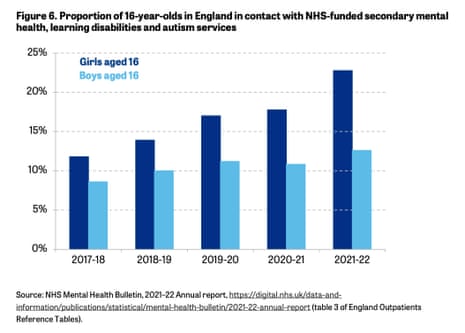
More than one in 5 girls aged 16 in England in contact with mental health, learning disabilities or autism services, IFS says
The Institute for Fiscal Studies thinktank has published a detailed report today on inequalities in disability. It has summarised the findings in a thread on Twitter starting here, but perhaps the most astonishing finding is summed up in this chart. It shows that in 2021-22 in England more than one in five girls aged 16 were in touch with NHS mental health, learning disability or autism services – double the rate four years previously.
The IFS says:
The NHS Mental Health Bulletin reports that in 2014–15, 3.4% of the overall population in England had had contact with NHS-funded secondary mental health, learning disabilities and autism services in that year, and this figure had grown to 5.1% in 2019–20, and 5.8% in 2021–22. This increase has been even more pronounced among younger age groups, and even more so among girls. As [the chart shows], the proportion of girls aged 16 who are in contact with these services increased from 11.8% in 2017–18 (the earliest year of the data for children), to 17.0% in 2019–20 and 22.8% in 2021–22. This means that among girls aged 16, more than one in five were in contact with NHS mental health services in 2021–22, which is a near doubling of the rate just four years earlier.
The IFS says that some of the increase is likely to be driven by a reduction in the stigma attached to accessing mental health services. More research is needed, it says. But it says even if that were the case, the pressure placed on services remains a problem.
The extent to which changes in reported mental health issues, use of mental health services and receipt of disability benefits for mental health conditions are due to changes in people’s reporting rather than an increase in the rate of poor mental health remains an interesting question for further study. But one might argue that, regardless of the extent to which the reported increase in mental health issues is actually due to underlying changes in mental health, there is also a legitimate concern about the pressures on public services, which the administrative data confirm to be very real.
The Campaign for Family-Friendly Trains has praised two rail operators for taking “significant steps” towards making it easier for families with young children to use their services.
It praised Merseyrail and LNER as it published a scorecard ranking rail operators (or at least those who responded to its survey) according to their family-friendly facilities.
It says:
UK trains have been traditionally designed for business and commuter passengers, not for families with young children in pushchairs. The significant challenges of accessing trains with a pushchair exacerbates social exclusion, but when leisure trips drive rail revenue then the industry can no longer afford to overlook and undervalue the needs of families. There are still many opportunities for train operating companies across the UK to improve their offer to young families.
And here is the scorecard.
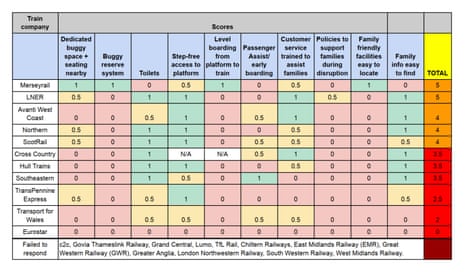
Referring to the two firms with the best record on this measure, the campaign says:
The fact that a long-distance operator (LNER) and a commuter network (Merseyrail) have both taken significant steps towards introducing family-friendly facilities and services illustrates the possibility for all train operating companies to make changes to improve the experience of families with young children.

Libby Brooks
Patrick Harvie, co-leader of the Scottish Green party, has warned of “toxic forces” resulting in a rise in homophobia after he was verbally abused on the street during a BBC interview.
Harvie was launching his party’s campaign for the Rutherglen and Hamilton West byelection yesterday when a man interrupted the interview, urging people not to vote for his party and calling him a “deviant”.
Harvie told BBC Scotland News:
Those who have cultivated this nasty kind of culture war against minorities need to take responsibility for verbal abuse like that but also for violence that we’ve seen rising against LGBT+ people.
Yesterday Humza Yousaf, the Scottish first minister, posted a message on Twitter saying the treatment of Harvie was “disgraceful, disgusting and completely unacceptable”.
I understand people hold strong views about politicians but there is simply no excuse, none whatsoever for bigotry and hatred aimed towards anyone.
Disgraceful, disgusting and completely unacceptable. Solidarity with @patrickharvie
I understand people hold strong views about politicians but there is simply no excuse, none whatsoever for bigotry and hatred aimed towards anyone.
Disgraceful, disgusting and completely unacceptable. Solidarity with @patrickharvie https://t.co/q8LXD8C2JI
— Humza Yousaf (@HumzaYousaf) August 22, 2023
Jack Straw and Matt Hancock join calls for Lucy Letby inquiry to be made statutory
Two former cabinet ministers have joined the growing chorus of people saying the inquiry into the Lucy Letby murders should be a statutory one.
Jack Straw, the Labour former cabinet minister (one of his jobs was justice secretary), told the Today programme this morning that the inquiry should have the power to compel witnesses to give evidence, which it won’t under the non-statutory basis currently proposed by the government. He said:
You can shame a lot of [witnesses] but you can’t shame them all, and there may be witnesses in the Letby case who really ought to be on the stand, who are the most vulnerable in terms of the positions they have taken, and who won’t be bothered about being shamed – they would rather be shamed for their absence than actually appear on the stand.
Being able to compel a witness is really very, very important.
Straw also said he did not accept the government’s claim that a statutory inquiry would take longer. He said:
There isn’t really any direct connection between whether an inquiry is judicially led with full powers and whether it is speedy.
And, in an article for the Times, Matt Hancock, the former Conservative health secretary, says this case is so serious that only a statutory inquiry will suffice. He says:
Steve Barclay, my successor as health secretary, was commendably rapid in proposing an independent inquiry after the verdicts were announced. I can understand, having stood in his shoes, why he favoured a non-statutory inquiry, as they can be faster and less expensive than full statutory inquiries.
But this case is too serious, the crimes too heinous, and the importance of leaving no stone unturned too great. Already the admirable doctors and managers who ended the cover-up have made very serious allegations about what happened. We have seen that Letby herself has refused to go to court for sentencing. We know there will be messages and paperwork that the inquiry needs to see, not just the official record but messages between decision-makers.
The Institute for Government thinktank has also called for a statutory inquiry. It has published an article by Emma Norris, its deputy director, saying “it is possible to combine the unique powers of a statutory inquiry to force individuals and institutions to cooperate, with the speed needed to make changes quickly”. She also says there is precedent for a non-statutory inquiry being upgraded to a statutory one.
In 2000, the non-statutory inquiry into the murders carried out by Harold Shipman was converted into a statutory inquiry after families successfully argued there should be a judicial review of the original decision. More recently, the Independent Inquiry into Child Sexual Abuse, the Brook House inquiry and the Post Office Horizon inquiry have all been upgraded from non-statutory to statutory inquiries to strengthen their powers.
Labour won’t give full details of its spending plans until final OBR report before election, McFadden says
And here are some more lines from Pat McFadden’s interview with Sky News this morning.
-
McFadden, the shadow chief secretary to the Treasury, said that shadow cabinet ministers all accepted the need for Labour to take a “responsible” approach to the public finances. That meant they accepted they would not just be able to “spend, spend, spend”, he said. He went on:
That message has come not just from Rachel Reeves and I, but also from Keir Starmer. And, to the credit of the shadow cabinet, I don’t think it’s one that they are resisting or punching back against. I think everyone recognises that responsibility is needed in the public finances.
-
McFadden said Labour’s spending policy would be governed by the fiscal rules it set out two years ago, which said that the government should only borrow for investment, not for day-to-day spending, and that it should get debt falling in the long term.
-
He said that Labour would not publish details of its spending plans until after the publication of the final Office for Budget Responsibility report before the general election. He said the party needed to know what state the public finances were in before it made commitments. The OBR produces two reports a year, and the next ones will be published later this year, with the autumn statement, and in the spring, with the budget. McFadden said it was possible the next election might not happen until after next year’s autumn statement, when there will be a further OBR report. He said Labour would have to wait until all those “fiscal events” had happened until it knew “exactly what the public finances look like going into the election”. Asked when Labour would reveal its plans, if the election were in October, he said it would depend on whether there was an autumn statement first.
McFadden said Labour would not rule out giving more visas for Indian workers as part of trade deal
Kemi Badenoch, the business and trade secretary, is visiting India where she will be holding talks on the post-Brexit trade deal being negotiated. Kalyeena Makortoff has more on this on her business live blog. She reports:
Badenoch is heading to Jaipur, where G20 trade and investment ministers will be gathering for talks on Thursday and Friday. But reports from the FT (£) and BBC suggest that the UK trade minister will use it as an opportunity to try iron out “some quite significant issues” to the trade deal, which – if it’s successful – would be a significant feather in Tory ministers’ caps post-Brexit
It is hoped that an agreement could slash costly tariffs on UK exports, including cars and whisky. Meanwhile, India is looking for a deal that would help improve access for its own manufactured goods and services, as well as work visas.
However, both news outlets suggest it’s unlikely that a deal will be struck before the prime minister, Rishi Sunak, attends the G20 summit on 9-10 September in New Delhi, where he is expected to hold talks with his counterpart, Narendra Modi.
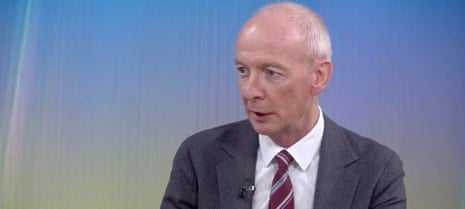
In his Sky News interview this morning, Pat McFadden, the shadow chief secretary to the Treasury, said a trade deal could potentially bring big benefits. He said India was about the UK’s 12th biggest trading partner, but that it could be a “huge trading partner”.
Asked whether Labour would be in favour of granting more visas to Indian workers in exchange for trade concessions, he said the party would not rule this out. He replied:
It depends what else is in the pot … You wouldn’t rule it out because you might have other interests that made that sensible. There are goods and services that we want to export to India that could create huge wealth in the UK if we got the chance to do that.
You’ve got to look at these things in the round. You can’t just say, where do we stand on visas without, for example, financial services. Or, for example, whisky exports. What’s in the pot in the round? Take a view of that and ask, ‘Is this deal in the interests of the UK?’ If it is, great. If it’s not, then don’t sign it for the sake of signing one. That’s the principle that should inform trade deals with major economies.
Labour says Tory calls for tax cuts based on better-than-expected borrowing figures pose ‘big risk’ to economy
Good morning. Westminister politics is largely on auto-pilot at this point in August and, for better or worse, most of the political establishment is in “out of office’” mode. But some visceral instincts never take a holiday, and so it was yesterday that, within hours of ONS figures coming out showing the budget deficit for July a bit lower than forecast by the Office for Budget Responsibility (OBR), Conservative rightwingers were calling for tax cuts.
The Financial Times has the best round-up. In their story, Valentina Romei and George Parker report:
Sir John Redwood, a former Tory cabinet minister, said the OBR had been “ridiculously pessimistic” in its forecasts and that Hunt should act swiftly to cut taxes and hold down public spending.
Redwood added that by cutting some businesses taxes — for example raising the VAT threshold for small companies — and reducing energy taxes, the economy could grow faster without fuelling inflation.
Sir Jacob Rees-Mogg, former business secretary, said the data exposed “the continued failure of the OBR” and that the scale of the forecasting gap left scope for tax cuts.
“This would pay for the total abolition of death duties and leave billions to spare — but more importantly it illustrates the mistake of setting policy based on the OBR’s auguries,” he added.
Meanwhile, David Jones, deputy chair of the pro-Brexit European Research Group of Tory MPs, said: “I do think that there is more fiscal headroom now. There is a greater tax take, and that will be augmented by increased savings income as a consequence of higher interest rates.
“That should be converted into personal tax reductions. The chancellor should also be looking to stimulate the economy by reviewing the rate of corporation tax.”
This morning Labour’s Pat McFadden, the shadow chief secretary to the Treasury, hit back. In an interview with Sky News, he said that last year’s “disastrous mini-budget”, which included unfunded tax cuts, should serve as a warning about the dangers of taking an irresponsible approach to the public finances, and he said the borrowing figures for July published yesterday did not change that. He went on:
[The mini-budget] is not an experiment we want to repeat. I was a bit alarmed at hearing Tory calls to repeat it yesterday. I think that’s a big risk for the country – certainly not one that we would adopt.
McFadden said that Labour was not opposed to tax cuts, but that they had to be affordable. He went on:
We saw last September what happens if tax cuts are unaffordable and judged to be unaffordable. And the consequences at that time were booster rockets under mortgage, rates, the Bank of England having to rescue pension schemes and a real rocking of international confidence in the UK economy. So you can’t go down that road unless it’s affordable.
So for us, always, this term – responsibility and stability with the public finances.
To be fair to the government, Jeremy Hunt, the chancellor, was also stressing the need for responsibility yesterday, and playing down the prospect of tax cuts. But, unlike McFadden, Hunt has backbenchers on his own side openly disagreeing with him.
I will post more from the McFadden interview shortly. After that, God knows where we’ll end up – there is almost nothing in the diary for the day – but we’ll find some news somewhere.
If you want to contact me, do try the “send us a message” feature. You’ll see it just below the byline – on the left of the screen, if you are reading on a laptop or a desktop. This is for people who want to message me directly. I find it very useful when people message to point out errors (even typos – no mistake is too small to correct). Often I find your questions very interesting, too. I can’t promise to reply to them all, but I will try to reply to as many as I can, either in the comments below the line, privately (if you leave an email address and that seems more appropriate), or in the main blog, if I think it is a topic of wide interest.
[ad_2]
READ SOURCE


